

The Shomari Figures Interview: "We need to focus on the South"
The Alabama candidate on growing up with parents in elected office, his state's long-term promise, and making politics work for real people.

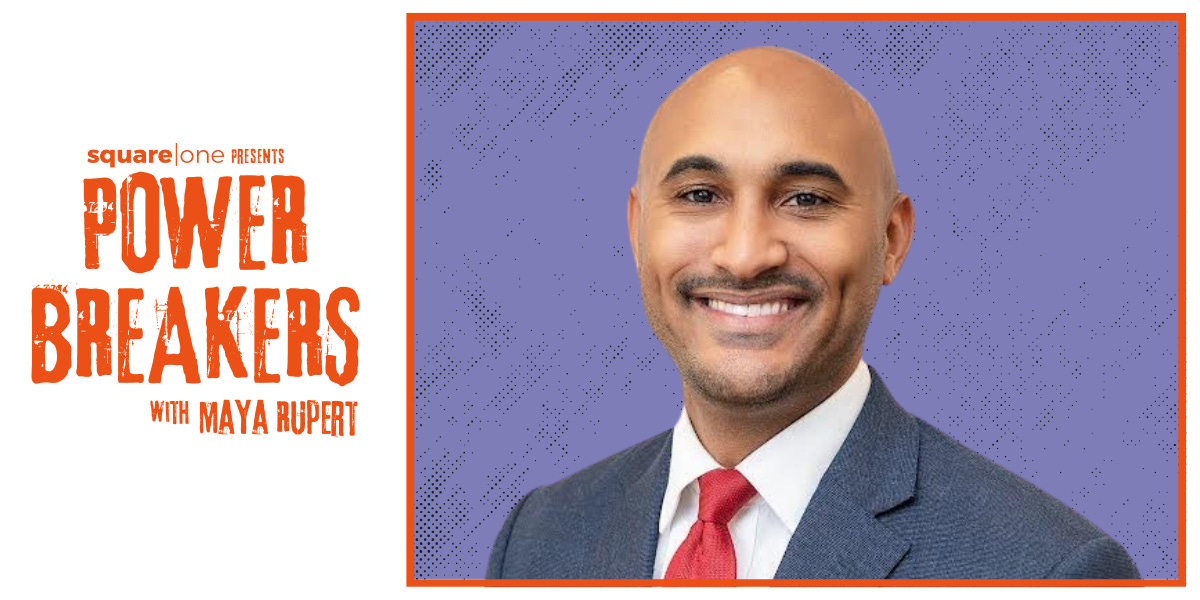
Welcome back to Power Breakers from Square One, the interview series where every other week, we’ll bring you a conversation on the people and ideas that matter in this election cycle and beyond. We’ll make you think. We’ll make you question. We’ll make you hope.
When—thanks to a redistricting win—Alabama’s 2nd congressional district was redrawn to better represent Black voters in the district, it immediately became a critical race that could help Democrats regain control of the House. It prompted a lot of people to start seeing potential in this district.
Shomari Figures, on the other hand, has always seen potential in the district. More than an opportunity to regain control of the House, Shomari sees his race to represent the people of AL-2 as an opportunity to help improve the lives of the people in his community, to use government as an instrument of good—a lesson he learned from his public servant parents—and to make sure that Democrats take notice of what is happening in Alabama, and in the Deep South more broadly, and begin investing now. Because as he told me, the Deep South may not be “as deep red as the electoral outcomes suggest.”
And his enthusiasm is catching. It’s why people are so fired up about this race, including Square One which is proudly supporting his campaign. The Democratic Congressional Campaign Committee (DCCC) named it to its highly competitive “Red to Blue” signaling a deep investment in this critical race. Shomari isn’t taking anything for granted, and is building a strong and diverse movement to give AL-2 the leadership it deserves.
Maya Rupert: Why don’t we start by talking about your journey. You kind of grew up all around politics, so what prompted you to want to serve?
Shomari Figures: I had the privilege to be raised in a house of public servants. Both of my parents were elected officials. My father was a state senator, and my mother was on the city council in Mobile. Then after my father passed away suddenly in 1996, my mother ran for that state senate seat, and is still in it. So there has not been a single day of my life where one or both of my parents were not elected officials.
So I grew up in that space of knowing what public service looked like and knowing what being focused on the issues in your communities looked like. Civil rights were always at the forefront. My father integrated Alabama's law school, and then was a civil rights attorney in the Mobile area. And he brought and litigated the case that led to the bankruptcy of the Ku Klux Klan back in the 1980s after they lynched a young man in Mobile.
And so I just grew up in that environment where the question was presented to you on a daily basis: How do you take what God has given you and use it for the benefit and the betterment of the people and places that mean the most to you and that are responsible for you? And for me, that has always been home. That's always been Mobile. That's always been Alabama. When you grow up Black, especially in Alabama, you learn pretty early the role that the federal government has played historically in making this state do right by Black people.
And that is something that always resonated with me, and was one of the motivating factors for me seeking out a career in the federal government. Coming out of law school, I've had the privilege to work across all three branches of the federal government. I clerked on the federal court. I've worked in the U.S. Senate and the White House. I've worked at the Department of Justice on two different occasions. So I’ve gotten an inside-out understanding of how the federal government works and how we can best leverage it to bring solutions and relief.
MR: And after all those experiences, you wanted to go back home to Mobile to serve?
SF: Absolutely. At the end of the day, this district is home for me. This is where I was born and where I was raised. It's where I was educated. It's who prepared me to have that career. And I don't think I would have had the chance to work for President Obama if I'm not from Mobile, Alabama. I truly believe that because I believe it has informed my view of the world and how I approach issues.
I was at the DOJ, and then, obviously, this seat that I’m running for was the product of Voting Rights Act litigation. This is a newly redrawn seat that came out of a Voting Rights Act challenge brought by plaintiffs in the State of Alabama that argued that after the last census, the state legislature had racially gerrymandered the congressional districts. Even though Black people make up nearly 30% of the state's population, there was only a legitimate chance for a Black candidate to win one of seven Congressional seats, and so even this Supreme Court found, at least preliminarily, that there was a likely violation and required the districts to to be redrawn.
And so given the history of Alabama—Montgomery is in this district, and it’s the birthplace of the civil rights movement and a centerpiece of what America is today—it’s amazing to possibly have the opportunity to represent people in this district and area that has such historical significance to this nation and to the world.
MR: It’s so moving to hear you talk about your parents and your community, and it raises an interesting question for me: You said that you didn't live a day where one or both of your parents were not an elected official, and that motivated you to go into politics. But I feel like sometimes when people see so up close what it means to be an elected official, they don’t necessarily want to run for office. What did you see or experience that made you know you wanted to do it?
SF: So, my parents being in elected office wasn't so much the motivating factor for me to seek out elected office as much as it was a factor for me to want to go into public service in general. I just knew I wanted to be involved in trying to use government to do good and to better people's lives in the community. I honestly never thought that I would run for public office. Certainly not at this point in my life.
I'd always thought that if I did it, I’d be a little bit older, the kids would be out of the house, and only if the right position and opportunity were there. But this moment afforded a very unique chance at a very unique time. When this case came down, we saw it as an opportunity where we could take that experience and that passion and that care and that concern for improving conditions at home, and put it to use in a more tangible fashion.
MR: So obviously you speak so clearly about what this community has meant to you, but outside of Alabama, we only hear about communities like yours in the context of a deep, red state where Democrats are going to be challenged to get things done. Why do you think it is important for us to be investing in building in the deep South and Alabama in particular?
SF: Look, these are the people in communities that America doesn't see and they don’t hear. And I personally don't believe Alabama is as deep red as the electoral outcomes suggest. I just think we've gotten to an environment where people don't go vote in the numbers that would truly reflect a more balanced electoral outcome in this state. And that's in large part because people have been turned off. People have felt let down. People feel that their vote doesn't matter for what's going to happen with the conditions and opportunities that they have in their communities.
And so you know, it's our job to make sure that they understand that it does matter. People do care. Leadership has been failing you. I mean, here in the State of Alabama, we've had Republican leadership at pretty much every level of the state government for the last twenty years. They've controlled both branches of the state legislature for the better part of the last fifteen years. And what has that led us to? Right where we are: The state has for all intents and purposes the lowest life expectancy in the nation. Our kids read at the sixth worst literacy rate in the nation. Wages are the fourth lowest in the nation. Incarceration rates are the highest in the nation. Our median individual income here in the state of Alabama is $39,000 a year.
And so what’s been happening, it’s just not working for people.
People need government to step up. There are thirteen counties in this district. Two of them are big counties—Mobile and Montgomery—if you set them to the side that's eleven counties left. Two of those counties already didn't have hospitals. So that leaves just nine other counties, and we've had four hospitals close just since we've been in this race in the last year.
So this is what people are dealing with. How do you begin a conversation about improving economic opportunities in your district and recruiting companies when your pitch to a company starts with the fact that you don't have a hospital?
And so that’s why we need to focus on the South. It's because what's happening in Alabama is also replicated in Mississippi. It's replicated in parts of Georgia. It's replicated in parts of Louisiana and Texas and Florida. These are the people who have not been the focal point of government, but we need to focus on them because they need it and because if we don't do it right, we know the outcomes in those communities are only going to get worse.
And we can change the electoral outcomes too. Mississippi's governor's race was just within a few points. We have two Democratic senators in the state of Georgia, and their last two gubernatorial races have been relatively close. Louisiana just had a two-term Democratic governor. Kentucky has a Democratic governor. So it's happening in and around us. And Alabama's not that different. If we can get the resources here, and the organizational structure here, and the investments here, we can do it.
MR: That’s a very hopeful message. Are you seeing that reflected in your conversations with voters? When you are talking to people, what are the issues and messages resonating with them?
SF: It’s about helping them understand how the issues we talk about connect to and impact their lives. For example, Medicaid expansion. As I mentioned earlier, Alabama has basically the lowest life expectancy in the nation. We're number three behind West Virginia and Mississippi by mere decimal points. So literally, we’re talking about a difference of weeks or months in life expectancy.
And yet we're one of fewer than ten states that have refused to expand Medicaid, which would provide healthcare access in the state of Alabama to more than 300,000 more people. And think about those hospitals that have shut down. If Medicaid had been expanded—it's not a permanent solution—but we know those hospitals would have been around for at least another decade.
So it's making people understand that when we're talking about Medicaid expansion, we're talking about your grandmother, or your grandfather, or your mother or your father. We're talking about those people who have a job, they've worked their whole life, they make too much money to be eligible for government benefits currently, but they don't make enough money realistically to be able to afford health insurance on an open market. And if you have to make the choice every month between paying rent or mortgage and health insurance, rent is always going to be undefeated.
So when they get old enough and become eligible for Medicaid or Medicare, they're dealing with issues that plague our communities like hypertension, high blood pressure, diabetes, or needing dialysis — all these negative health care outcomes that could have been avoided or treated if they’d just been able to go to a doctor and get preventative screening.
Or I’ll talk to a voter and they’ll tell me, “I don't think social security is going to be around for me.” Okay. That's fine to feel that way, and you can grind it out in your life to make sure you have the resources to support yourself when you get older. But what if it's not there for your mother? Who has to take care of mom then? And is that going to impact your ability to take care of yourself in the future if you have to expend those resources, taking care of an aging parent or an aging grandparent?
So it’s about walking people through what this all means and making it resonate with them.
MR: We are so close to people actually getting out and voting. I'm sure you're out there talking to people on doors and making calls. Have there been any stories from the trail that you’re taking with you into these final days that are giving you hope?
SF: It’s a lot of different stories. When young children recognize you, that’s powerful. I’ll walk by them, and hear them whispering, “That’s Shomari Figures!” And that means something is resonating with them that's not an entertainer or an athlete. It’s someone they see making a positive effort in their community. Obviously not that entertainers and athletes can’t do that, but those are common for them to see. If they recognize me, and then say, “But who is he?” What is he doing.” Now they’re curious about what it means to try to fix issues in their communities. And that’s giving me a lot of hope.
I’m also really inspired by the diverse coalition of support that we've been able to garner around the state. Our coalition has younger voters, older voters, we’re building support across racial lines, and among people who are historically less likely to vote. That gives us a lot of hope. And finally the focus that this race is garnering from a national media standpoint is really inspiring because it shows that people care about what's going on down here, and they recognize the value of this opportunity that we have in this race. There are a lot of people who are giving us hope in this race.
This interview has been condensed and edited for clarity.
Power Breakers is fueled by Square One, the national non-profit dedicated to electing women, people of color and LGBTQ+ candidates. Help us elect breakthrough leaders and shine a light on inspiring stories with a contribution.
